Showing posts with label Theatre. Show all posts

Wednesday, 5 January 2022

“Ah, But Underneath”: Words, Music and Character Development


She was smart, tart 

Dry as a martini—

Ah, but underneath…

She was all heart

Something by Puccini—

Ah, but underneath...


Ah, But Underneath, Follies - Original London Cast, Stephen Sondheim


Julia McKenzie, dressed in a white silk dress, walked slowly to the centre of the stage, dry-ice swirling around her feet, and picked out by a single spotlight. Then she stopped, looked off into the middle distance, and began to sing “Losing My Mind”. She stopped the show.

It was 1987 and I was sitting in the audience at the Shaftsbury Theatre, London, watching Follies, my first West End musical. I had heard so much about this musical, about the A-list cast taking to the stage in it, I had already bought myself the cast recording of it before seeing it. “Losing My Mind” was a torch-song about unrequited love, but listening to that album I had no idea of the power of that song. Sitting there in the theatre, that song hit me face-on, and it stopped the show. I could feel other people around me reacting in the same way.

Now, Julia McKenzie is a very fine actor, with a wonderful singing voice, but it wasn’t just her performance of that song, it was her performance that whole evening. We had seen how her character was deluding herself, chasing after a lost love from twenty years before and denying the problems in her marriage. When we reached the part of the musical where she sang “Losing My Mind” near the end of the second act, we knew this woman and we felt so sorry for her; we were swept up in the real nature of the song because we were hearing it in context.

My mother always loved musicals but she loved the big, Hollywood, romantic musicals. The musicals where the action would stop for its great love songs and it always had a happy ending where the star-crossed lovers found happiness together. I hate those musicals, especially the unrealistic nature of them where the action stops for another song. Growing up, I was sure I didn’t like musicals; well, I didn’t like the ones I had been exposed to.

As a teenager I discovered the television show The South Bank Show. This was a weekly arts show, broadcast on a Sunday night. Unlike most arts shows then, it wasn’t a magazine show, filled with short segments about different and often unrelated subjects; The Show Bank Show would dedicate the whole show to one subject, one writer, one artist, one film, or one play. One Sunday night in 1980, it was about the musical Sweeney Todd, which was soon to premier in London. I watched it in amazement. The musical was about multiple murders and cannibalism, not your usual musical fare. (It was based on the London legend of Sweeney Todd, the barber who slit the throats of his customers, and his sidekick Mrs Lovett, who cut up those bodies and cooked them into meat pies.) But it was more than just a musical horror story; the songs examined the nature of revenge and the destruction of a man’s mental health. I was fascinated and I’d discovered my first musical hero, Stephen Sondheim.

Three years later, a touring production of Sweeney Todd came to Manchester; I was still living with my parents in Liverpool. I persuaded my parents to take me to a matinee performance. I was a teenager and learning how to “persuade” my parents to let me do what I wanted to do. It was a musical and that was enough to appeal to my mother, and my father went along with it because my mother wanted to. My mother, though, after the curtain rose and the songs began, rapidly disapproved of it, and she could disapprove with a force like thunder. The last song of the first act is called “A Little Priest” and is a comic song about cannibalism. My mother was audibly huffling throughout it. During the interval, my mother announced, “Tommy, this isn’t what I call a musical!”

My father replied, “But it’s very interesting, dear, and those actors are taking good parts.” We stayed for the second act.

The atmosphere in the car on our journey home that day was tense. My mother silently oozed disapproval; it had not been her idea of an afternoon spent at the theatre, especially as the second act seemed drenched in murder and madness. I sat in the car’s backseat silently because I had been swept away by what I had seen. It had been a fast-paced plot with a cast of not-so-lovable characters, but it had also discussed some big themes like the nature of revenge, how destructive it can be, and how it doesn’t give you justice or peace. This was what drama could be about.

I had to wait until I’d left home and moved to London to see my next Sondheim musical, Follies. This was a very different musical, about the 1970s reunion of the Follies Girls, showgirls from a 1950s musical extravaganza. This musical was about relationships, nostalgia and how we can fool ourselves with both, plus it didn’t have a neatly happy ending. It showed me how fantasy can be used so effectively in drama, where the characters can step forward and tell the audience what their problems are, in this case with four very different and very original Follies numbers. “Losing My Mind” is one of these numbers.

Since then, I’ve had the opportunity to see theatrical productions of all his musicals; some have been memorably good, some have been easily forgotten. Sondheim’s musicals do demand so much from actors and production, they are not easily staged in a room above a pub with mediocre actors. Living in London, I have been fortunate to have been able to see some amazing theatrical productions, and so many of them have been Sondheim’s musicals.

What Sondheim’s musicals do, which I found revolutionary when I first saw them, is that his songs still carry the plot forward. In one of his musicals, the plot does not stop for a song; instead the songs are so important to the plot, moving characters and plot forward. His lyrics also capture the characters’ speech patterns; you can hear their dialog in the lyrics of the songs they sing. The meaning of the emotions in his songs deepens when you hear them in context, when you have spent an evening with the characters who are singing them, when you know who they are and why they are singing that song.

Sondheim’s most famous song is “Send in the Clowns”. It is always sung as a romantic song, a love song, but in the musical it is something very different. In A Little Night Music, it is sung by the character Desiree who has spent the musical chasing after Fredrik, an old lover who she thinks will make the perfect husband and father for her teenage daughter. In the second act, she finally gets Fredrik alone in her boudoir and he tells her he really loves his wife. She sings “Send in the Clowns” as her reply. The song is an “oh shit” song. She has finally got Fredrik where she wants him, but he doesn’t want her and she realises she really doesn’t want him. It is such a human and awkward moment, but you do not get that if you only hear the song out of context.

It was a great joy introducing Martin, my husband, to Sondheim’s musicals. I had worried at first that he wouldn’t like them, that he would see them just as camp froth, as so many people claim them are. Fortunately, he saw in them what I do, he too enjoys the plots and characters that are carried along by Sondheim’s sharply lyrical songs, what he also enjoys are their plots. None of Sondheim’s musicals could be described as having “conventional” plots, no two of his musicals even have similar plots, but they always have fascinating plots, even if the plot does not hit the mark, like in Anyone Can Whistle.

When I first moved to London, the first gay men I met happily told me that Sondheim was gay, he was one of us. At first it was reassuring; such a genius like Sondheim was also gay. I found comfort in those famous and intelligent and creative men who were also gay. Later, I came to realise, as I read more about Sondheim and his life, that him being gay was one part of the outsider that he was and that his outsider-ness, not being at the heart of any of the societies he belonged to, made him such a talented composer and songwriter. He was looking in from the sidelines, not celebrating from the centre, and so could comment on all he saw, good and bad. I have found that in myself, so much of my writing is me looking in at something I didn’t fully belong to.

On the 26th November 2021, Stephen Sondheim died. He was at home with his husband when he did.

He has been called a titan of musical theatre and he certainly did reinvent the musical form. But I fear that we won’t get another Sondheim. He made his songs an integral part of the musical’s plot, but musicals have changed so much in the last thirty years. They now cost hundreds of thousands of pounds to stage and MUST be a hit. So we get lots of revivals and jukebox musicals, musicals based on the back catalogue of a famous singer or group or musicals based on famous eighties blockbuster films, which use eighties pop hits as their songs. Musicals with a big and ready audience before they even open, musicals that guarantee a happy ending. Unfortunately, I do not see any space for new composers and songwriters who are trying to do something different, like Sondheim. But there is always fringe theatre.

With his death, I have lost the hope that maybe there could be a new Sondheim musical somewhere in the pipeline. He was not the most prolific of composers but always produced quality over quantity.

I do have the hope of more productions of his work. In 2017, the National Theatre staged a production of Follies. They got every element of it right; the casting, staging, orchestration and direction were so right that they generated a perfect production and we got to see it. It is a memory I will happily never forget.

Drew

Saturday, 18 May 2013

Art is the Best Revenge


Desperately Seeking the Exit, Peter Michael Marino’s one man show

What do you do when you’re in a foreign city, you’ve written the book for a musical but everyone has their own “ideas” about it and aren’t talking to you, you’re smoking so many cigarettes that British American Tobacco shares have gone up 5%, everyone keeps asking you if you’re “all right” when you obviously aren’t, you’re bleeding from the rectum, you throw yourself in front of a bus in desperation but it’s going so slow it doesn’t harm you and Debbie Harry is delighted she “wrote” your musical? You go mad or write a one man show. Peter Michael Marino did both, though not at the same time.

In 2007, Marino wrote the book for the stage musical version of the film Desperately Seeking Susan, with the music of Blondie and Debbie Harry. The show lasted four weeks before closing, not so much flopping as crashing and burning. But was Marino disheartened? You bet. Out of the ashes of that disaster, and after a lot of therapy, Marino had created his one man show Desperately Seeking the Exit.

Fortunately, this isn’t the “pity-me” style of theatre. Marino tells his story with humour and energy, but this is still the dark side of show business. This show is about the failure of a West End musical, the crash and burn of this musical and the effect it had on Marino. But in the same way this isn’t a self-pity show, it isn’t a downbeat and depressing one. Marino has a sharp and lively sense of humour and fills his show with it, making us laugh at his nightmare experience.

I never knew that producing a musical was such a long twisting journey. Marino’s humour navigates this journey for us, with the constant changing “vision” for his musical, as director, chirographer and then producers all add their “ideas” for how the show should be and Marino’s nightmare deepens. His is a truly nightmarish journey downwards, at one point I even wondered how he survived (when he described a two hour meeting to find an alternative to the word “pot” you knew all hope was lost), this world was as unreal as Lewis Carol’s Alice stories. Marino also proves that, even in the theatre, the writer is at the bottom of pile but the first to be blamed when things go wrong, even when it’s all taken out of their hands (So, not much different then for writers elsewhere).

A lot of Marino’s humour does come from the differences between American and British culture, though his are much more intelligent insights then how we pronounce tomato and the temperature of our beer. At first, I was disappointed to hear so many jokes about our differences but as show when on they served to show his alienation, he was in a foreign country as everything went wrong.

From such dark material Marino has crafted a lively and funny show, with a heart that is all too human. This is a must-see show for Marino’s insights into the madness of producing a West End musical and his always sharp humour. Unfortunately we saw Desperately Seeking the Exit at the end of its run at the Leicester Square Theatre but Peter Michael Marino will be performing it elsewhere so check him out online. Unlike the musical, this is no flop.

The website Desperately Seeking the Exit.

Desperately Seeking the Exit on Facebook.

Desperately Seeking the Exit on Twitter.

Desperately Seeking the Exit on SoundCloud

Desperately Seeking the Exit on Tumblr

How to write a West End flop, BBC online article about the show

Original Guardian review of Desperately Seeking Susan (The Musical), and it’s not good.

Drew

Sunday, 17 June 2012

Frankenstein on Screen

Four days ago we went to see the National Theatre’s production of Frankenstein, staring Benedict Cumberbatch and Jonny Lee Miller, but we didn’t see it at the theatre.

Earlier this year the National Theatre broadcast a live transition of Frankenstein into different cinemas around the country. Four days ago they re-broadcast it and we wert to see it, at the Vue cinema Dagenham.

The production was amazing and full of the theatre magic the National Theatre does so well. The play was written and performed from the point of view of The Creature, rather than Frankenstein, and opened with the painful and disorientating “birth” of The Creature. It portrayed him as someone driven to revenge and murder by the complete rejection he suffers from society just because of his looks. Whereas it portrayed Frankenstein as the arrogant scientist who creates life and then does not know how to handle that responsibility, he’d driven The Creature away as a “mistake” after its birth because it was so deformed, and there he hoped it had died. When The Creature returned to his life, Frankenstein can’t cope with the reasonability of what he’d done.

Benedict Cumberbatch played The Creature as someone trying to regain speech and movement after a brain injury. Jonny Lee Miller played Frankenstein as a strutting and arrogant man laid low by what he has done.

The production was magical and so tightly held our attention, yet it never stopped to preach a “message” at us, instead it concentrated on its dark and gothic story, letting the morality flow out of the story. It also stuck very closely to the plot of Mary Shelley’s book. This wasn’t a simple horror story, but a dark fable about the dangers of science.

The strangest thing, though, was our setting. The Vue Dagenham is a very suburban cinema, mostly showing Hollywood Blockbusters. For that screening of Frankenstein there was only Martin and I in the whole auditorium, which seated about two hundred people. I’ve never been the only person in a cinema before, it felt also decadent, but it also felt a little sad (We were the only people in the area taking the time to see this great production). What we didn’t feel was alone. Frankenstein had been filmed before a sell out audience and we could hear the audience’s reaction to the play. With surround sound it actually felt as if the cinema had a full audience, people laughed at the humour and gasped at the horror.

You can find out more about the National Theatre Live (live broadcasts of their productions) at their website.

Drew.

Sunday, 20 May 2012

And Her Lips Never Moved

Last night we saw Nina Conti, at Menier’s Chocolate Factory, in her new show, Dolly Mixture. She’s a ventriloquist (She's also Tom Conti's daughter) but her show was much more adult entertainment than children’s party.

Her show consisted of six different puppets, all of them very different. There was the tactless monkey, Monk, who has made Nina Conti’s names, plus five new characters; her eight year old daughter, her reformed rescue dog, a randy polish builder, her Irish Aunt who has reached the age where she no longer gives a f*ck and one of her old professors who has lived so long that he doesn’t want to have to carry on living any longer. The humor here was very adult, plenty of jokes about sex and even death, and not once did she drink a glass of water while the puppet chatted on.

This was certainly a “work in process” show, some of the characters/puppets didn’t work as well as others and some of the humor didn’t as flow as smoothly in some places, but still it was far better than a lot of comedy I’ve been exposed to; it made me laugh. Nina Conti certainly has an eye and an ear for characters, but unusual characters. Her puppets aren’t the standard stereotypes beloved of traditional ventriloquists, they were far too off-the-wall.

As a child I’d never warmed to ventriloquists, they were always very clever but the puppets never seemed to come alive with their characters. This was the nineteen-seventies and we still had the tradition of Music Hall and Working Men’s clubs. Ventriloquists fell into the traditional double-act, a straight-man who feed the feed-lines to the comic, the ventriloquist being the straight-guy and the doll was the comic. Their routines were that of line joke, line joke, line joke; their routines weren’t the character driven stories that was the main stay of Nina Conti’s show.

To Nina Conti her puppets were more than just props on her knee, she interacted with them. She made eye contact with them, reacted to them, she even laughed at their comments, but she was far more than the straight-man feeding lines for the jokes. At times it felt as if she didn’t know what the puppet was going to say, even though she’d obviously worked closely on her show. She has taken character driven comedy and applied it to the ventriloquist act, giving us something fresh and interesting.

I have always enjoyed character driven comedy over stand-up joke telling, the jokes coming out of a character’s reaction to a situation, rather than the smart put-downs of a comic. Nina Conti certainly performs the comedy I enjoy and she has breathed life into the stale old ventriloquist’s act.

Watch some videos of Nina Conti’s act here, on YouTube.

Drew

Sunday, 6 March 2011

Ruby Wax – Losing It

Yesterday, we went to see Ruby Wax’s two women show, Losing It. Again, it was another autobiographical show, but fortunately Ruby Wax has something very interesting to say.

The format of this show was simple, Ruby Wax told her story and Judith Owen supplied the accompanying songs and music; but this wasn’t Ruby Wax talking and then stopping for one of Judith Owen’s songs. Almost seamlessly, the two women slipped between Ruby Wax’s monologue and Judith Owen’s songs, both perfectly complimenting each other.

The theme is Ruby Wax’s experience of depression. Not just what happened to her when she had a mental breakdown but what lead up to this. It was an almost cautionary tale of the damage that fame can do to someone, especially when fame starts to slip away from someone who was once on the top of it all. Her view of fame is unflattering, especially the things she tried to do to keep that fame (She described it as addictive as Crack Cocaine), also her account of the little she had to do when she was famous was also unnerving.

Her description of her breakdown was all too real, the sudden stop in her hectic activity then fall into a deep and unmoving depression. Her depression was a real depression, not the kind so often portrayed in fiction, which is no more than feeling a little blue or down. Her depression robbed her of energy, her personality and her desire to do anything.

Fortunately this show portrayed depression in all its reality. This wasn’t a show were Ruby Wax turned her mental problems into a tragedy on the lines of “poor little me, how terrible it was”, or a “look how funny mad people can be”; neither was this a new-age-spiritual-journey whereby she becomes a “better” person because she fought depression. This is an uncomfortable but unsentimental look at one woman’s experience of depression.

Ruby Wax has a very engaging and animated stage presence, her energy levels during the show pushed it forward in a way that held your attention, yet when she was slowed down by depression it was almost heart-breaking. Judith Owen’s songs were a perfect addiction to Ruby Wax’s monologue, not drawing away from it, and delivered in a clear and soul voice.

The moment telling moments came in the Q&A session after the show. Ruby Wax was asked did coming through depression make her a better person, she flatly replied “No”. I wanted to cheer with relief. So often people will talk about how depression can make someone more caring, compassionate or whatever, ignoring the pain and suffering that mental illness leaves in its wake. I was so grateful for her honesty.

Hopefully people will come to see this show because of Ruby Wax’s fame but I hope they’ll leave with a better understanding of what depression actually means, Ruby Wax is certainly able to deliver that.

More details on Losing It can be found at these websites:


Drew.

Sunday, 20 February 2011

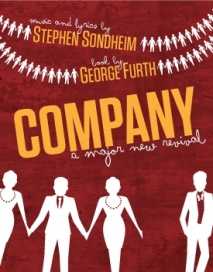
Company, at the Southwark Playhouse.

It’s not so hard being married, it’s much the cleanest of crimes,

It’s not so hard being married, I’ve done it two or three times.

Lyric from The Little Things We Do Together, Company.

Company is musical that takes a sideways look at marriage. Most musicals follow the plot of boy meets girl, there is an obstacle in their path, they overcome that obstacle, boy and girl lives happily-ever-after. Not so with Company, it takes a look at marriage and relationships and finds them wanting.

The plot here isn’t a simple journey from A to B, the plot or lack of it revolves around one man and his friends and relationships. Bobby, the central character, is a man living in New Year and on the eve of his thirty-fifth birthday. He’s single and has a reluctance, even fear, about being in a relationship; he can’t commit to a relationship and is running three girlfriends at once. The musical takes the form of different scenes of Bobby with his friends or girlfriends, with the songs acting as commentary on the action or forming part of scene.

The different married couples all have different problems in their relationships. There’s the overly competitive couple, who even complete when they give things up. There’s the couple with the repressed and mousy wife and dominating husband, but theirs makes for a sort of wedded bless, not wife abuse. There’s the couple who are happier together once they are divorced, though they don’t separate. There’s a woman marrying the man she’s lived with for years, on the morning of her wedding day decides she doesn’t want to get married (this scene was both painfully funny and very touching). Then there’s Joanna (the character who gets two of the best songs in the show), a very bitter and angry woman whose has driven away two husbands but her third husband is deeply in love with her and won’t leave her. Threaded all of this is Bobby and the mess he’s making of his life.

Bobby is a character not often seen today, an adult male, who doesn’t act like an overgrown teenager, afraid of marriage and commitment. We’ve see many female characters like this and male characters who are no more than overgrown teenage boys, but rarely are they adult men like Bobby. The musical never examines why he’s like this (there’s no song about his awful childhood, etc...) but it looks at the effect it has on his life. He doesn’t want to be alone but he doesn’t know what or who he does want.

Also, for a musical, there is a large number of female characters here, the wives being more interesting than their husbands, but this is more about its characters than it is about the musical’s plot. Each character having their moment of revelation in their scene with Bobby – Joanne’s bitterness falls into place with her scene with Bobby, late in the second act.

The Southwark Playhouse’s production certainly puts the spotlight on the character’s. The bare stage, with its three level platform upstage, doesn’t just give the characters space to breathe but to shine. It is very much about the people on stage and not the scenery around them.

For a musical, especially one on at a fringe theatre, there wasn’t a bum note sang here. All the cast had fine and on key singing voices. Their acting too hit all the right notes, though some of husbands certainly having the weaker roles. Rupert Young, as Bobby, was both handsome and charming, he brought a sort-of boyish charm to his role, giving his female friends mothering of him a sexual edge. Of the supporting actors, Siobhan McCarthy (as Joanne) and Michelle Bishop (as Bobby’s very New York girlfriend Marta) stood out. It was a surprise and pleasure to see Mark Curry (The one time Blue Peter presenter) here in the role of Larry, Joanne’s long suffering husband.

I first saw this musical over fifteen years ago, when I was single and not being successful at relationships, and found it very disturbing. In Bobby I saw a character that I didn’t want to turn into and feared that I might. Now, I’m older and have been with my partner over ten years, I didn’t find Company that uncomfortable. Now, I was able to sit back and enjoy the portrayal of the characters here, the crazy and unhappy people, I was also able to watch Bobby twist himself into knots over relationships.

Company was first performed in 1970, it’s over forty years ago and yet it hasn’t aged a day. This production is set in the present day and feels completely appropriate. It certainly doesn’t feel like a period piece or a story very much of its time. How many other musicals from the early 70s are still relevant today?

Drew


Tuesday, 15 February 2011

"My Trip Down The Pink Carpet"

“I was sweating like a paedophile in a Barnie costume”
Leslie Jordan

Three days ago we went to see Leslie Jordan’s one-man-show “My Trip Down The Pink Carpet”, which is adapted from his biography of the same name. Leslie Jordan is famous from his roles of Beverley Leslie, on Will & Grace, Brother Boy in Sordid Lives, and numerous other supporting roles in TV programs like Ugly Betty and Boston Legal. But this wasn’t a show business story, where he spent the whole evening bragging about which stars he’d worked with the kind of performer who only values their worth through the stars they’ve worked with.

Leslie Jordan is short, effeminate and gay, all qualities that didn’t single him out as Leading Man material. His show, as does his autobiography, chronicles his experiences as a gay actor in Hollywood trying to find his big break, as his tries to deal with the shame and self-hatred about his sexuality, from his up-bringing as a Southern Baptist, and the drug and alcohol and male hustler addictions that came from all that self-hatred. Though he has a very natural gift for comedy (this man could make reading medical notes sound funny, and that’s a gift) so much of this show was heart-breaking in his honesty.

His breakout role on Will & Grace wasn’t even written for him (it was written for Joan Collins, but he tells that story better then I can) and he nearly missed the audition because he took a phone call from his mother, which was a strange tail about a woman in her church who got shot (!!).

His show did contain other bizarre and funny stories like this (The one about his first experience of phone sex had me nearly crying with laughter), but they often contained a darker edge – the story of his first experience on a Hollywood TV show soon turned into a nasty experience of homophobia because wasn’t “butch enough”. These stories, so neatly woven together by Leslie Jordan’s so natural stage presentence, told of the flip-side of Hollywood, those who work hard just for a career (Not fame).

But the overall theme of this show is survival, not just in Hollywood, but also from the homophobia that he was almost smothered with growing-up. Leslie Jordan lived through many years of drink and drugs addiction, which he’s not shy about, and then lived through an even harder recovery from that. His description of his own rehab and recovery was both painfully honest and painfully funny, this man can really tell a story. Of all he has achieved he is proudest of his sobriety, another telling moment.

This one-man-show is far more than just the tale of gay man in Hollywood, Leslie Jordan’s story is much more about the homophobia in American society and its effect upon him. He has a natural feel for comedy, which saved this show from being sentimental and melodramatic, but more than that he’s a natural storyteller. This is one of those shows that is more than worth the price of its tickets.

I’ve now started to read the book this show is based on.
 
Drew

P.S. The second picture on this blog Martin took of Leslie Jordan, at the book signing after the production we saw.

Sunday, 5 September 2010

Into The Woods (Regent’s Park Open Air Theatre)

Fairy Tales aren’t easy.


Stephen Sondheim’s fairy tale musical, Into The Woods, has a simple premise. A childless baker and his wife must lift a curse that has left them barren. To do so they have to go into the mysteries woods and bring back, for the witch who cursed them, a cap as red as blood, a cow as white as milk, a slipper as pure as silver and hair as yellow as corn (Little red Riding Hood’s cap, Jack of Jack and The Bean Stick’s cow, Cinderella’s slipper and Rapunzel’s hair). So the baker and his wife go into the woods and mix up everyone’s stories.

 
By the end of the first act all their stories are neatly tidied up, they all have what they want (Cinderella and Rapunzel have their princes, Red Riding Hood has her wolf skin coat, Jack is rich, and the baker and his wife have their child) and they all live happily ever after. The second act deals with the consequences of the characters’ action. To get what they want each character has to do something dishonest or corrupt (not doing what they’re told, pretending to be something they’re not, deliberately lied or stole) and now their actions have come back to them. There’s a giant loose in the kingdom intent on revenge and characters are rapidly being killed, not all by the giant. Eventually, the survivors band together to defeat the giant, but even then things aren’t returned to normal. The survivors return to a shattered world.


The themes of this musical very much reflect the time it was written in, the 1980’s, a critique of the yuppie greed principal, the end justifies the means (Only recently, we saw this with the banking boom that lead to the credit crunch). Here that greed has its consequences. Many people have expressed their disappointment with the second act, they liked the interwoven plots and tidy ending of the first act; they don’t like the chaos and death (many of the musicals popular characters being killed off) plus the downbeat ending. To me, though, the musical would be incomplete without this ending. The first act has set-up the different acts of dishonesty practiced by the characters, the second act shows the very messy consequences of these acts – for every boom there always comes a bust. In the world of fairy tales, and drama as a whole, actions always lead to consequences, to leave this out would led to an ultimately unsatisfying story.


Into The Woods contains examples of some of Sondheim’s best song writing. Here are songs that full of irony (“Agony” and it’s reprise), songs that mine deep emotions (“Our Little World”) and even songs with tunes that refuse to leave your head (The title “Into The Woods”), yet all of them come very much out of the characters. These songs, if performed out of the context of the musical’s plot, loose so much. The song “Hello Little Girl”, song by the wolf as he stalks Little Red Riding Hood, has more menace, sexuality and plot then the whole of damn Twilight series (!!).


This year is Stephen Sondheim’s eightieth birthday and this production is a fine present for him. Both musically and technically this production lives up to the promise of the material. The acting, though larger-than-life as the writing demands, was the perfect pitch, mixing broad comedy with pathos that gripes at the emotions; also there wasn’t bum note song here (so often actors are shoe-horned into a musical for their fame or looks, then their singing voices are poor at best). Out of a company of strong performances those of Hannah Waddingham (as The Witch) and Jenna Russell (as The Baker’s Wife) stand out. Hannah Waddingham plays The Witch as two different characters, a waddling gargoyle before her transformation, and as a strutting vamp who speaks the unacceptable home-truths as the post transformation character. Jenna Russell makes The Baker’s Wife the emotional heart of the piece. In the first act she’s the one pushing her husband forward to get what they want, to make their moral compromises, to lift their curse. In the second act, she’s the first to realise the threat the giant poses.


The costumes have a very stylised 1950’s feel, tailored tweed jackets and pinched waist dresses, which gives the impression of a children’s story illustration from the time – ideal for the style of this musical. The set is simple, if not basic, consisting of different platforms and walkways; but it was the setting of the theatre that made the perfect setting for this musical. The Open Air Theatre is housed in Regent’s Park and surrounded by tall trees, these trees form the perfect back-drop to Into The Woods. The set merges with these trees, Rapunzel’s tower actually being placed in one of them.


As a child I always found the endings of fairy stories strange, the idea of “they all lived happily ever after”. I wanted to know anyone could manage that. I once got into trouble, in Junior School, for asking this. When I first Into The Woods, back in 1990, I found it met that childhood need in me... Since then, it has remained of my favourite musicals.


Drew.